Thursday, 14 October 2010

Kyúdõ-Japanese Archery

Monday was a national holiday, Sports Day.  We went to see an ancient archery demonstration at Yasukuni Shrine.  


Shrine entrance

Yasukuni Shrine


Alec wrote the following paper:

Kyúdõ

By Alec Condry


        Kyúdõ literally meaning "way of the bow" is the Japanese art of archery.  Archery began in 500 BC.  Then the need for archers rose in 1180-1185 for the Genpei War.  From the 15-16th centuries Japan had many wars.  


        The Japanese bow is called a yumi.  It is usually two meters tall.  Bigger than the archer and mostly the bows are made of bamboo.  But sometimes they are not. All archers hold their bow in the left and shoot with the right.  There are three levels of skill for archer. Tooteki is where you just have to hit the target, kanteki is where you have to pierce the target, and zeiteki is where you have to get the arrow to stay in the target.  The yumi (bow) and the ra (arrow) shafts are both made of bamboo.  


        The other day I got to see Japanese archery and I thought it was really cool because the bows looked pretty lethal.  But, the arrows had rubber tips.  I would like to try it sometime soon but I am not fifteen, the age you can start this sport.


the judges


one the the archer helpers, each archer had his or her own attendant

the target

preparing to compete


archer one

archer two

the winner taking her bows

ready (men have to remove arm from sleeve)

aim

fire!

Alec's pic of standing bows

Tuesday, 12 October 2010

Yunishigawa Onsen

Bathing is extremely important in Japan.  There are right ways and wrong ways to do it.  Most homes have an ofuro, a deep, deep small tub for the family to bath in each night. The water is usually kept at slightly below scalding levels and you never bath before you are entirely clean as the water is not changed between bathers. Families without ofuros make use of the local public bath or sento.  Additionally, Japan has hundreds of onsen, or natural hot springs, both indoor and outdoor.
Our ugly, unused as yet ofuro

When Nick was in daycare as a one year old we used to have to record how often and how long we bathed him on a daily basis.  Bathing is not only important in Japan, it is an art form.  Many Japanese take onsen vacations.  You definitely have to give up modesty as wearing bathing suits is not allowed.  All onsens have separate sex bathing areas while a few also have unisex areas with rules against ogling.


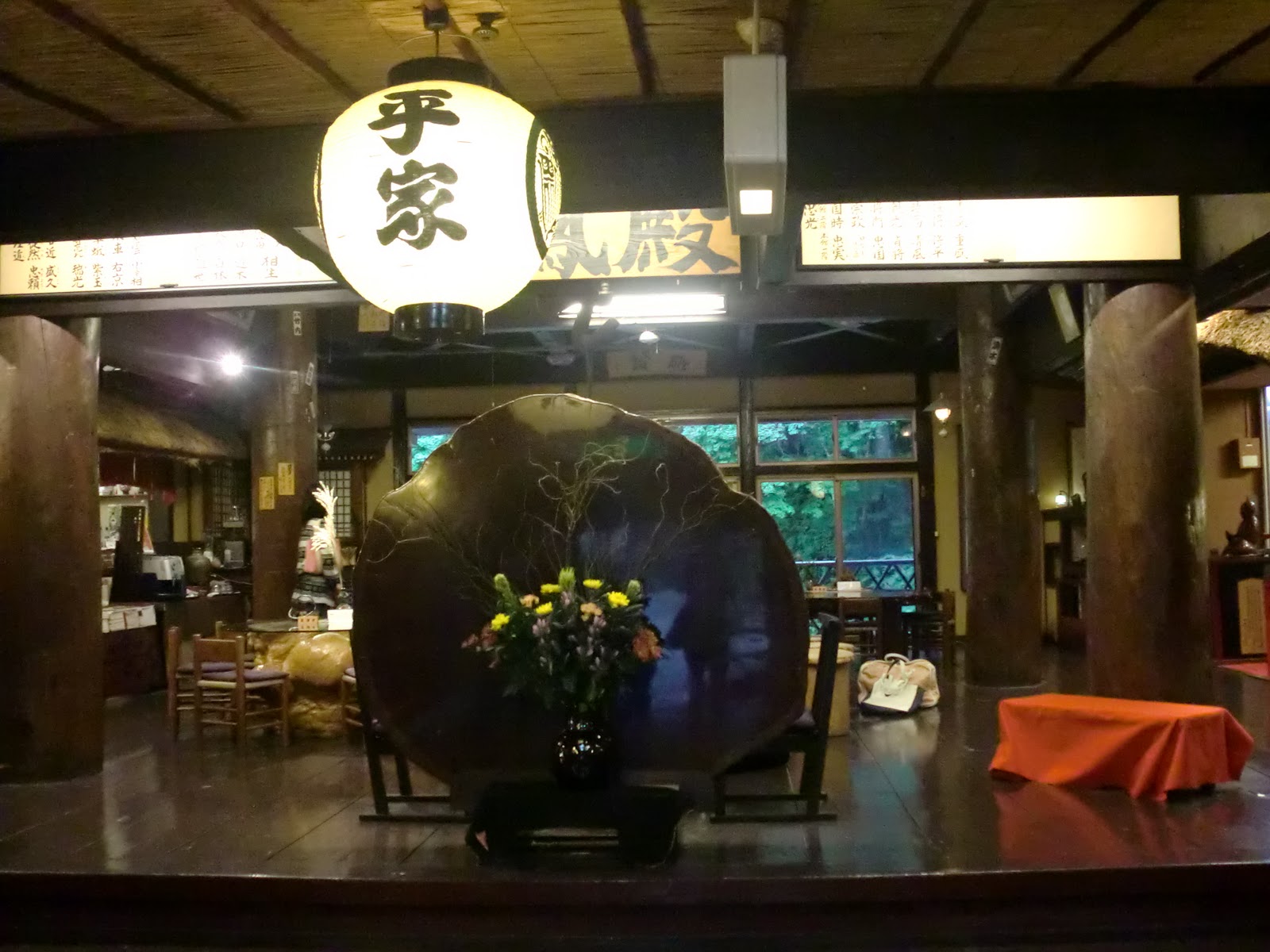
We chose Honke Bankyu Bankyu Ryokan in the mountain town of Yunishigawa.  The area was discovered and settled in 1573 by the Heike clan who were seeking refuge and a hideaway after being defeated and kicked out of Kyoto.  This place was definitely off the beaten path.
Yunishigawa Onsen

Reception Area

at mini on-site museum

reception

Ornate Ceiling
Overlooking the rope bridge and river

  It took many hours and forms of transportation to get tot he hotel, the last being a bus which winded its way along steep, narrow mountain roads.  Upon arrival we were formally greeted by the sounding of a drum and led to our tatami mat rooms overlooking the Yunishigawa river.
They're here!
 The kids loved that the rooms included a head to toe massage chair in the vestibule area.

Leisure wear in our room overlooking Yunishigawa river
We quickly settled in with green tea and red bean paste snacks and changed into the  yukata you wear around the hotel.  Then we set off to explore the hotel and take our first bath and hopefully not embarrass ourselves or bring shame to the family in the process.


three little maids are we...
The staff helped Sandy, Nancy to dress for some traditional photos.

The women's section of the onsen consisted of a women's spa locker room area.  Then the pre-bath shower area where you squat on a 12 inch stool and meticulously clean yourself.  There was an indoor onsen which was crazy hot, but we moved to the outdoor rotenburo surrounded by rocks overlooking the river and stayed through sunset.  There were only a few other guests in the hotel and after the first 15 minutes, we had the whole onsen to ourselves.  Ahh.


lit nighttime crossing

rope bridge by day
down the hallways to our dining room
Dinner was across a rope bridge in a private dining room around an irori or open heath.


Some of it was already laid out when we entered.  Then four more hot courses were brought while three courses cooked over the open fires in front of us.  Our host explained the order in which to approach the meal and gave us hints for timing as don't eat the river fish on a stick until all the water has flowed out it's mouth?!  Many of the items on our plate were unidentifiable and some were better left unknown.  I have to say that I could not muster the courage to try even a bite of the raw pheasant sashimi (I am sure that Kirsten would agree).  But, much to Ian's surprise, I did try the deer sashimi and liked it until the words "RAW DEER" began to repeat in the head.


Sandy waiting for meal to begin
Jackson happy to have kids meal as more things were fried than not
Our individual tray: pheasant sashimi is top right and deer is top middle-doesn't it look tasty?

looks like marshmallows, but actually toasted pounded rice, notice wet spots in sand from fish spitting up

our private digs

When we returned to our rooms, our futons had been laid out for the night and in the morning we repeated our bath and meal routine, this time with an elaborate, yet unusual breakfast buffet.

We certainly left cleaner than we arrived.


Tuesday, 5 October 2010

Noashima Island and Himeji Castle


Alec at the Uno ferry dock

outside the town public bath that has been turned into an art project
We had heard  about an "art island" located off  the larger island of Shikoku in the Inland Sea and thought it was a good time to check it out.  Naoshima is a tiny island with two small fishing communities.  The modernist architect Takao Ando has developed part of the island into several unbelievably beautiful museums and art spaces while several other artists have taken old, dilapidated buildings in Honmura, one of the two small towns on the island, and turned them into art house projects.  The whole island can be traversed in a day by foot.  http://wikitravel.org/en/Naoshima
Yoyoi Kusama's Pumpkin 

 The super rich and wealthy stay at Benesse House which is part of the museum complex and stunning in itself.  The riff raff like us stay in comparably cheap digs in town.  We stayed in a family run ryokan or pension.  It was fine, but you had to follow the mama-san's rules.  Dinner was at 5:30 sharp and she would yell for you to come and even open the sliding door to our room to say hurry up or no food.  The same for 7 a.m. breakfast which did not include tea or hot coffee, but had plenty of cabbage, tofu, rice and miso soup.


 We had heard that the island was a "heavenly" experience and while it wasn't as charming as we expected it grew on us.  I guess part of the problem was the steady rain.  We definitely didn't need our bathing suits.  In the end, we got the full art experience, just not the sun.  The nice thing that we all noted was that each space was minimal so you never felt overloaded or tired by the works.

they love lady liberty here

town police stopping all traffic including bikes to say be careful and hand out sponges and chewing gum (if only Boston had these kinds of issues)

town home with hot water heater on roof
 I have to say that it was the architecture built in and among the hillsides that was the most inspiring to me.  Each space fit and related to it's surroundings perfectly.  Unfortunately, none of my pics do the art or the space justice.  You can see it better on the link above.

peeking inside doorway in Honmura-everyday art


On the way home from Naoshima we stopped at Himeji Castle and zoo.  The castle was undergoing renovations so we didn't get to tour it in it's entirety, but luckily Alec was able to continue to add to his stockpile of Japanese weapons.


castle moat


castle walls

stopped the boys from spray painting the walls in the nick of time


Japanese zoos are pretty old school and depressing as noted by this green hyper-chlorinated polar bear.
global warming?

Samurai Alec

modern samurai with real sword from grandma and shuriken

Sunday, 3 October 2010

Two weddings, two festivals and a tea ceremony

Ian's mom and her friend Nancy have been visiting and while the weather has not been as accommodating  as we would like, read lots of rain, we have been on the go.  You know me:  go, go, go is my motto.

Sunday we took them for the rapid version of Shibuya, Yoyogi Park, Meiji Shrine and Harajuku.  It seemed that we would wandered into one festival and out another throughout the day.  Each neighborhood has a Shinto shrine and in the shrine, they have a mikoshi, a portable shrine that Shinto followers believe serves as the vehicle of a divine spirit which followers periodically take out and parade through the neighborhood in different states of traditional undress.
girl riding with taiko drum

here comes the fist mikoshi

traditional outfit

young and old alike

the mikoshi

even the dog's get in the act and stroller...
then the second mikoshi parade...

coming down takeshita street

having some fun with no pants on

a family outing


Weddings in Japan are typically a Shinto tradition as well, while funerals are Buddhist ceremonies.  Meiji Shrine is a beautiful peaceful oasis in the heart of Tokyo.  We were literally in crushing pedestrian traffic right outside the shrine entrance and then followed a long, serene gravel lane to the Shrine.
the gate to meiji shrine

in the courtyard

meiji shrine


 Because it is a very popular place to get married, one of the conditions is that the wedding party must consent to be photographed by tourists.  I met an extended British family whose son married a Japanese woman the day before at the shrine who recounted the fun they had being part of the procession.  They said they felt like rock stars.  We will be guests at a wedding next week, but the ceremony will be held at a small neighborhood shrine and only immediate family are invited to that portion of the celebration.
wedding couple number one

the bride and groom will rent their kimono as well as the wedding dress  and tux they will change into for the reception and then the evening gown for the after party

wedding procession number two

shinto priest and his attendants

the bride and groom

I brought Sandy and Nancy to a tea ceremony which was enjoyable.  I think the ceremonies for westerners have been modified and updated in a positive, if more cursory, way since I was here in high school.  I remember having to literally endure hours of sitting on your feet and not moving or falling asleep while your legs were completely numb and starving at the same time listening to the instructor drone on and never knowing when the end was in sight.  In this tea ceremony, we were fed right at the start some sweets that were almost palatable and the viewing of the ceremony did not require unnatural, extended sitting contortions.  I even enjoyed the taste of tea this time around.

our teacher

preparing the tea leaves

Sandy appreciating the tea cup before sipping

a perfect cup o' tea

yum


After the ceremony we met Ian and the boys at the Mori Museum in Roppongi for an installation art exhibit.


We ended the day with steaming, hot ramen at our favorite whole in the wall and jazz at our neighborhood spot.  The ramen shop is only a counter, so it took a little finagling to fit all 7 of us inside.  One of the patrons even stopped on his way out and asked us incredulously how in the world we knew about this place.  Actually, friends who are brother and sister owners/bartenders at our favorite 6 stool bar tipped us off to the place.

Jackson vs. the Ramen Bowl